Northeast Pennsylvania Consortium Creates New Model for Training Future Physicians
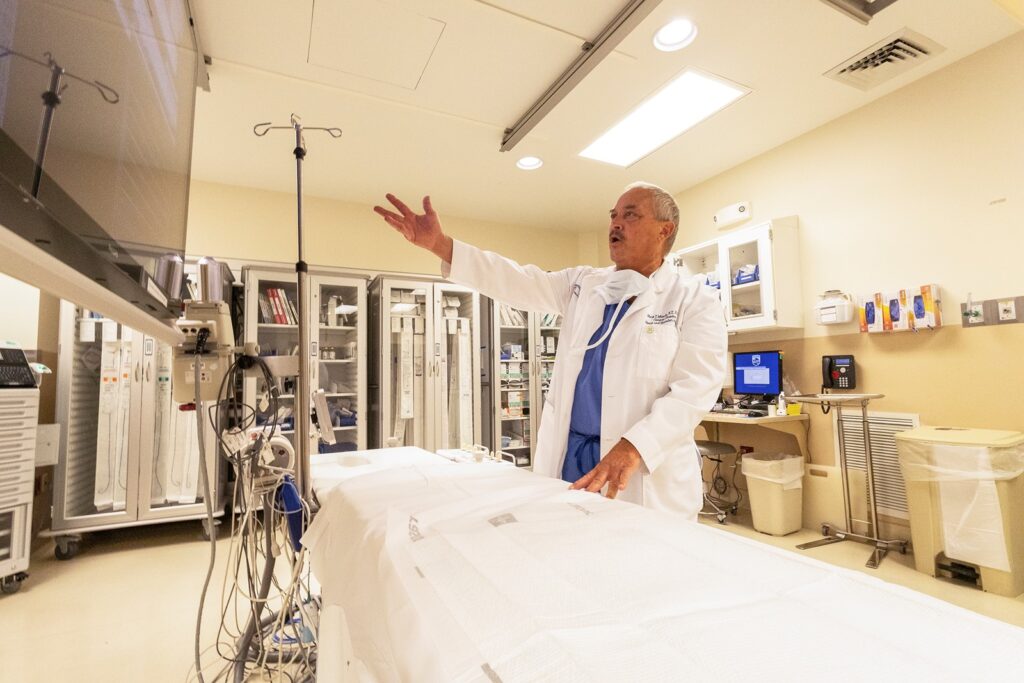
Mark Mileski, clinical director of the Heart and Vascular Institute, discusses the cardiac catheterization laboratory at Regional Hospital of Scranton on Wednesday. (Photo by Sean McKeag/Staff Photographer, The Times-Tribune)
Courtesy of the Scranton Times-Tribune. By Jeff Horvath.
SCRANTON - A collaborative initiative providing local clinical training opportunities for aspiring doctors is working in Scranton and could be a model for the rest of the country as officials here and elsewhere strive to address a physician shortage, stakeholders involved in the Northeast Pennsylvania Clinical Education Consortium said Wednesday.
Led by coordinator Lackawanna College, the consortium connects medical students from several colleges of osteopathic medicine in the northeast with local clinical partners — Commonwealth Health, Scranton Primary Health Care Center, the Wright Center, Allied Services and others — providing them opportunities to train at local hospitals and healthcare facilities. The goal is to create a pipeline of doctors who might plant roots and practice here, bolstering the physician workforce in a city and region with pronounced healthcare needs.
The innovative model uses the community as its clinical network, where community institutions, as opposed to a particular medical school, serve as a hub for osteopathic medical training, Lackawanna College President and Chief Innovation Officer Jill Murray, Ph.D, said. Participating students spend a year in the Scranton area completing clinical rotations for their third year of osteopathic medical school.
Stakeholders gathered Wednesday at Regional Hospital of Scranton to celebrate the consortium's success and tout its potential as a template for partnerships in other communities. Officially launched in 2024 with nine medical students participating in the first year, the consortium's capacity has grown since, with 36 participating this year.
Mark Speicher, Ph.D., the American Association of Colleges of Osteopathic Medicine's senior vice president for research, learning and innovation, touted the consortium as mutually beneficial for both the local healthcare partners and the participating osteopathic medical schools. At a time when many medical schools are facing increasing difficulty finding clinical training sites, "we don't have that problem here," he said.
The prospect of medical students who train here returning to the region to practice is a potential downstream benefit that excites officials and organizations with a vested interest in the long-term health of the region's medical workforce. Among them is the nonprofit Tenor Health Foundation that acquired Commonwealth Health and its Scranton and Wilkes-Barre hospitals earlier this year.
"We're seeing the shortage and how difficult it is to recruit, and my philosophy is if we provide for a good educational environment the students will stay," said Radha Savitala, Tenor Health Foundation's president and board chair. "They will make this their home if they are not from here, and if they are from the region, (they'll) want to come back."
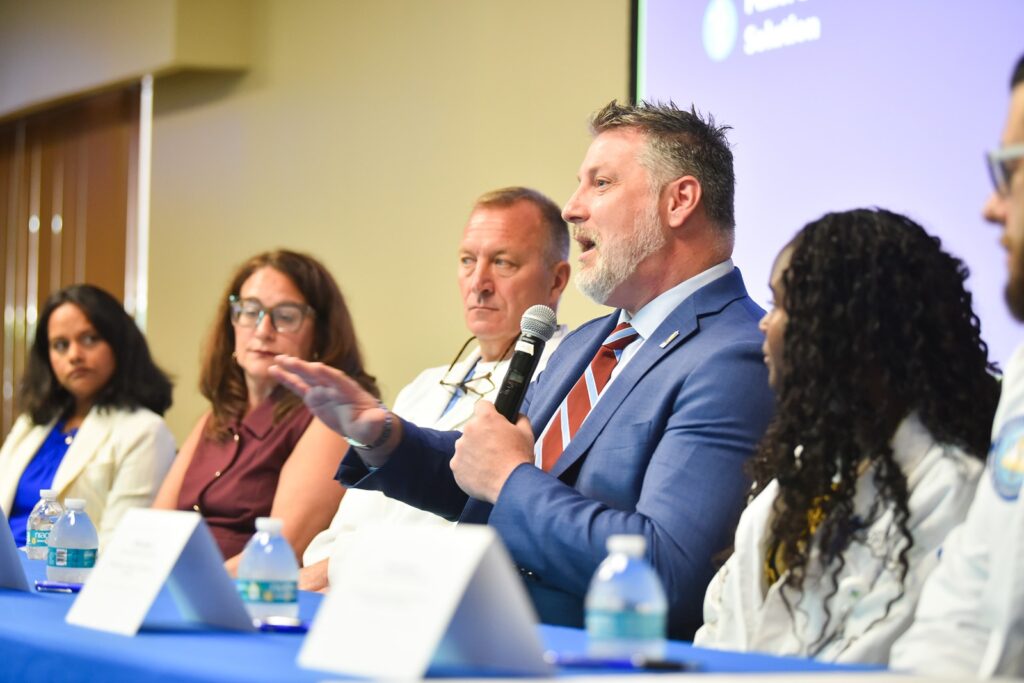
Peter Bidey, DO, dean and chief academic officer at Philadelphia College of Osteopathic Medicine, speaks on a panel with medical students and health care professionals during an event at Regional Hospital of Scranton on Wednesday. (Photo by Sean McKeag/Staff Photographer, The Times-Tribune)
David Karpe, a 30-year-old medical student at the University of New England College of Osteopathic Medicine training here through the consortium, could be a future example. His is one of three schools participating in the consortium, the others being the Philadelphia College of Osteopathic Medicine and Touro College of Osteopathic Medicine.
"My wife and I, we've been here for a little while (and) we've pretty much decided that we would love to stay as practicing physicians because we love the community here," he said. "I think that the community definitely is in need for physicians, and … even when I was applying for medical school I remember how important it was for me to practice in a community that needs me and (where) I would feel, like, appreciated and I would feel like I'm actually having an impact, as opposed to just sort of like a cog in the system."
"I think that there are tons of opportunities here to succeed," Karpe continued. "Again, when you collaborate, you have all these institutions coming together, you're not fighting for individual resources. You have access to this patient population, to that hospital, to these physicians, and you start to feel like a part of that community. … You go into being a practicing physician already knowing your patients, your population, where the need is and how you can contribute to that, and so all these things come together and they make me excited to stay here, to train, to be practicing in the area."
A local healthcare landscape made stronger by a pipeline of future physicians also promises broader benefits for the population at large.
"Healthcare is the reason people come to stay and live in a community," Democratic state Rep. Bridget Kosierowski, a longtime registered nurse, said Wednesday. "It is about housing, it is about education, but the most important thing is our health."
Speicher, the American Association of Colleges of Osteopathic Medicine official, identified the consortium model here as a replicable and cost-effective template for other communities looking to create similar workforce pipelines to meet their own healthcare needs.
"We are working hard to discover and develop more Scrantons," Speicher said. "We are working with schools and communities around the country that are in need of healthcare. We're trying to identify innovative leaders like you all … who can provide us with the leadership that is specific to that community just like happened here in Scranton."
"We know there is untapped community support for clinical education because you showed us there was untapped community support for clinical education," he said.