
Tenor, Commonwealth Health officials give update on regional hospitals
By Stephen Mocarsky UPDATED: April 27, 2026 at 5:08 PM ET
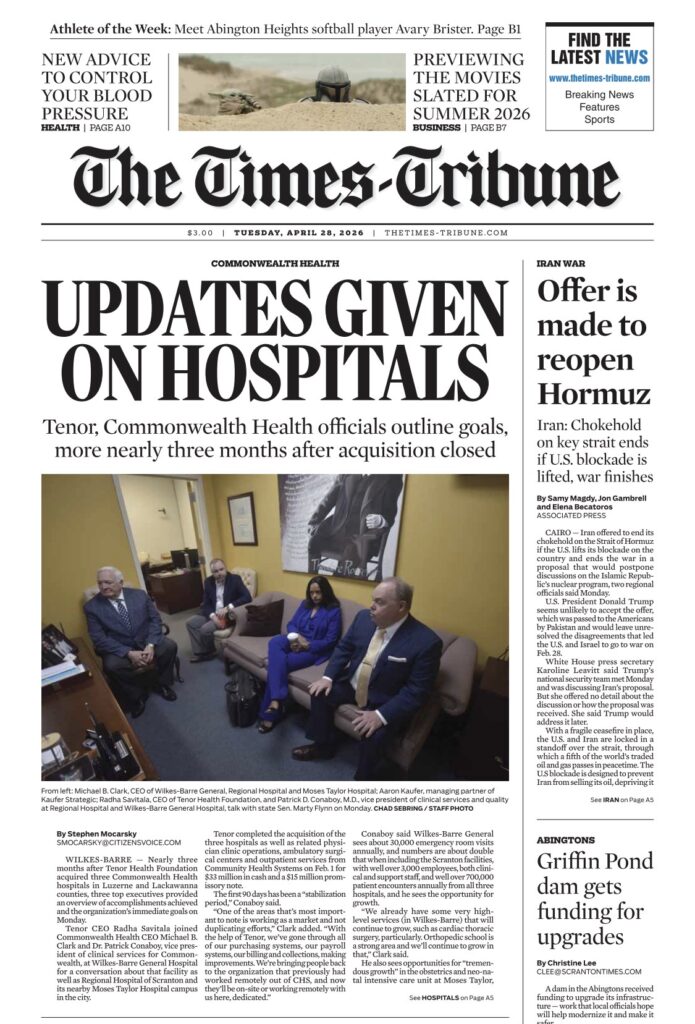
WILKES-BARRE — Nearly three months after Tenor Health Foundation acquired three Commonwealth Health hospitals in Luzerne and Lackawanna counties, three top executives provided an overview of accomplishments achieved and the organization’s immediate goals on Monday. Tenor CEO Radha Savitala joined Commonwealth Health CEO Michael B. Clark and Dr. Patrick Conaboy, vice president of clinical services for Commonwealth, at Wilkes-Barre General Hospital for a conversation about that facility as well as Regional Hospital of Scranton and its nearby Moses Taylor Hospital campus in the city. Tenor completed the acquisition of the three hospitals as well as related physician clinic operations, ambulatory surgical centers and outpatient services from Community Health Systems on Feb. 1 for $33 million in cash and a $15 million promissory note. The first 90 days has been a “stabilization period,” Conaboy said. “One of the areas that’s most important to note is working as a market and not duplicating efforts,” Clark added. “With the help of Tenor, we’ve gone through all of our purchasing systems, our payroll systems, our billing and collections, making improvements. We’re bringing people back to the organization that previously had worked remotely out of CHS, and now they’ll be on-site or working remotely with us here, dedicated.” Conaboy said Wilkes-Barre General sees about 30,000 emergency room visits annually, and numbers are about double that when including the Scranton facilities, with well over 3,000 employees, both clinical and support staff, and well over 700,000 patient encounters annually from all three hospitals, and he sees the opportunity for growth. “We already have some very high-level services (in Wilkes-Barre) that will continue to grow, such as cardiac thoracic surgery, particularly. Orthopedic school is a strong area and we’ll continue to grow in that,” Clark said. He also sees opportunities for “tremendous growth” in the obstetrics and neo-natal intensive care unit at Moses Taylor, which he said is the only such provider in the area."
Clark said there are currently no plans for closing any facilities, although the company recently hired an architectural space planning group to look at opportunities in Regional and Moses Taylor and compare infrastructure between facilities “to identify plant purchases that we would need to support each one. But this is very, very early in that process.” “It would be a costly endeavor to consolidate services, so, we want to do that very thoughtfully and make certain that we make the right choices for the patients,” Clark said. Restoration, expansion of services Asked about restoration of the emergency room at Moses Taylor, which closed in 2022, and inpatient childbirth services at Wilkes-Barre General, which ended in 2023, Savitala said leadership must continue a focus on stabilization for the time being. “Stabilization right now is first and foremost for us. We’ve had folks that have resigned, whether that’s clinical or support staff, and … both Dr. Conaboy and Michael Clark did a great job with reaching out to these individuals, as well as departments as a whole, to set forth a stabilization plan,” Savitala said.
“We’re happy to report that many of them have decided to rescind their resignation and stay. Part of the stabilization, as well, is to really operate as a market, which Commonwealth Health really has not done in the past. So, it is ensuring that the vital services that we provide in each of the regions are coming together so that, as a market, we can serve all of these counties and populations,” she said. Hiring problems dissipated Past hiring challenges compounded by uncertainty over whether one of both Scranton facilities might close have dissipated to a large degree. Now, potential hires see a future with the company. “We’ve been shocked by the number of people who want to come and work for us. The last couple years in both markets, but especially in the Scranton market, were filled with a lot of uncertainty,” Conaboy said. “Every request we have put out, openings for new positions, has been met with an avalanche of people. CHS had us convinced that nobody wanted to come to Northeast PA. It turns out, that is dramatically untrue.” “We have so many people applying who have been working in areas around New York and Philadelphia, etc, and they’re all saying the same thing. … You guys are in the perfect spot,” Conaboy said, noting the recent hires of two cardiologists and letters of intent from several other physicians. “The cost of living in this area is so much better than the Hudson Valley or those places outside of New York City or Philadelphia. The schools are fantastic. When we put out requests, we are now interviewing four to five doctors a week.
Conaboy deferred to Clark to discuss the importance of offering competitive salaries and benefits in the NEPA market to compete with Geisinger and Jefferson Health, “who have started what appears to be a nuclear war when it comes to trying to hire people.” Jefferson merged with Lehigh Valley Health Network, the owner of the former Hazleton General Hospital, in 2024. “We continue to have some difficulty in recruiting certain specialties. Every healthcare provider, certainly in the region, has a high need for specialized CT technicians and MRI technicians,” Clark said. Commonwealth Health is performing market studies on wages, benefits, shift differentials, on-call pay and other forms of compensation. They found that starting pay in Scranton is “very close to the market,” but there is a need “to make some adjustments further down so that we can continue to reward those employees appropriately,” Clark said To make Commonwealth Health “the very best places to work,” officials are bringing back things such as celebrations for terms of service “so that people can feel the appreciation that we have for them. We (are) … talking to the staff, asking, ‘What is going well for you, what could we help to improve?’ so that they know that we listen to them. … Being a bit of a smaller system, we can move quicker” to make those things happen, Clark said. Rural health initiatives Commonwealth Health officials hope they can acquire significant funding from the Rural Health Transportation Fund included in President Donald Trump’s One Big Beautiful Bill. “Our local rural communities depend upon Wilkes-Barre General Hospital and the Scranton hospitals to support them. While there are a number of hospitals in some of our five surrounding counties, there are actually one or two counties that don’t even have a hospital,” Conaboy said. “When they have something complex … those patients are transferred here. So, those rural communities are a real part of our mission, and always have been.”
Conaboy deferred to Clark to discuss the importance of offering competitive salaries and benefits in the NEPA market to compete with Geisinger and Jefferson Health, “who have started what appears to be a nuclear war when it comes to trying to hire people.” Jefferson merged with Lehigh Valley Health Network, the owner of the former Hazleton General Hospital, in 2024. “We continue to have some difficulty in recruiting certain specialties. Every healthcare provider, certainly in the region, has a high need for specialized CT technicians and MRI technicians,” Clark said. Commonwealth Health is performing market studies on wages, benefits, shift differentials, on-call pay and other forms of compensation. They found that starting pay in Scranton is “very close to the market,” but there is a need “to make some adjustments further down so that we can continue to reward those employees appropriately,” Clark said To make Commonwealth Health “the very best places to work,” officials are bringing back things such as celebrations for terms of service “so that people can feel the appreciation that we have for them. We (are) … talking to the staff, asking, ‘What is going well for you, what could we help to improve?’ so that they know that we listen to them. … Being a bit of a smaller system, we can move quicker” to make those things happen, Clark said. Rural health initiatives Commonwealth Health officials hope they can acquire significant funding from the Rural Health Transportation Fund included in President Donald Trump’s One Big Beautiful Bill. “Our local rural communities depend upon Wilkes-Barre General Hospital and the Scranton hospitals to support them. While there are a number of hospitals in some of our five surrounding counties, there are actually one or two counties that don’t even have a hospital,” Conaboy said. “When they have something complex … those patients are transferred here. So, those rural communities are a real part of our mission, and always have been.”
Commonwealth Health is considering several proposals for improving and/or expanding services for those rural communities through the Wilkes-Barre and Scranton hospitals with the federal funding. “Being able to take some of that care out into the communities, whether it’s through remote monitoring or on-site clinics, is something we’re looking at aggressively,” while also recognizing the need to extend obstetric services there, Conaboy said. “Being able to deliver that care closer to the mom and baby’s location is really important. A lot of women in those areas don’t get the prenatal care that they need, and a lot of the babies don’t get the follow-up care that they need.” The patient experience Savitala said officials are placing a major emphasis on being patient-centered and ensuring that quality standards are being discussed. “What I’ve heard in being out in the community is, the quality at (Wilkes-Barre) General, especially, has come down in relation to what it was years ago. And, that’s just not true,” Savitla said, noting accolades and recognition from various organizations to the quality of care at the hospitals. “Really, it is our mission to ensure that patients are the focus and that we are talking to the patients. Our chief medical officers are involved, as well as our quality folks. And when there are patients that are being discharged, we have conversations with them and talk about the experience,” Savitala said. “At the end of the day, when you have such large numbers of patient encounters, you need to ensure that they’re having the best experience they can,” Savitala said. “So, I think that’s one of the other shifts of focus — ensuring that the patients are feeling appreciated.”